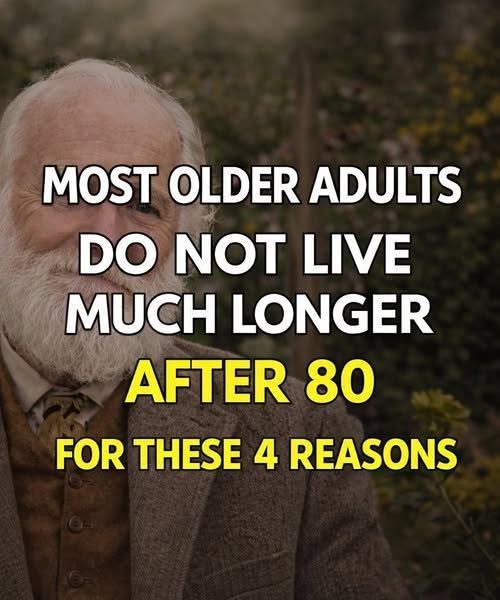
That headline is misleading and overly absolute. Many older adults do live beyond 80, and in several countries life expectancy is now close to or above that range, with growing numbers reaching their 90s and beyond.
What is true is that health risks increase significantly after 80, which is likely what the post is trying to explain.
🧓 4 real reasons health risks increase after age 80
1. Long-term chronic diseases build up
Over decades, conditions become more common, such as:
- Heart disease
- Stroke risk
- Diabetes
- Kidney disease
These don’t appear suddenly—they develop over many years.
2. The body becomes less resilient
With aging:
- Muscles weaken (sarcopenia)
- Bones become more fragile
- Immune response slows down
This makes recovery from illness slower and more difficult.
3. Higher risk of falls and complications
Falls become more dangerous because:
- Balance and strength decline
- Bone fractures heal slowly
- Hospital complications increase
Even minor injuries can have serious effects.
4. Reduced organ reserve
Organs gradually lose “extra capacity”:
- Heart pumps less efficiently
- Lungs have less elasticity
- Body handles stress less effectively
This is called reduced physiological reserve, not failure.
🧠 Important reality check
- Many people live healthy lives well past 80
- Lifestyle and healthcare have a huge impact
- Age alone is not a limit or prediction
🌿 What helps people live longer and healthier
Research consistently shows benefits from:
- Regular physical activity
- Balanced diet
- Not smoking
- Good sleep
- Managing blood pressure and diabetes
- Social engagement
- Preventive healthcare
🧾 Bottom line
It’s not true that “most older adults don’t live much past 80.” Rather, health risks increase with age due to natural biological changes and accumulated conditions. Longevity depends far more on lifelong habits and healthcare than on a fixed age cutoff.
If you want, I can explain what studies show about people who live past 90 and what habits they tend to share.