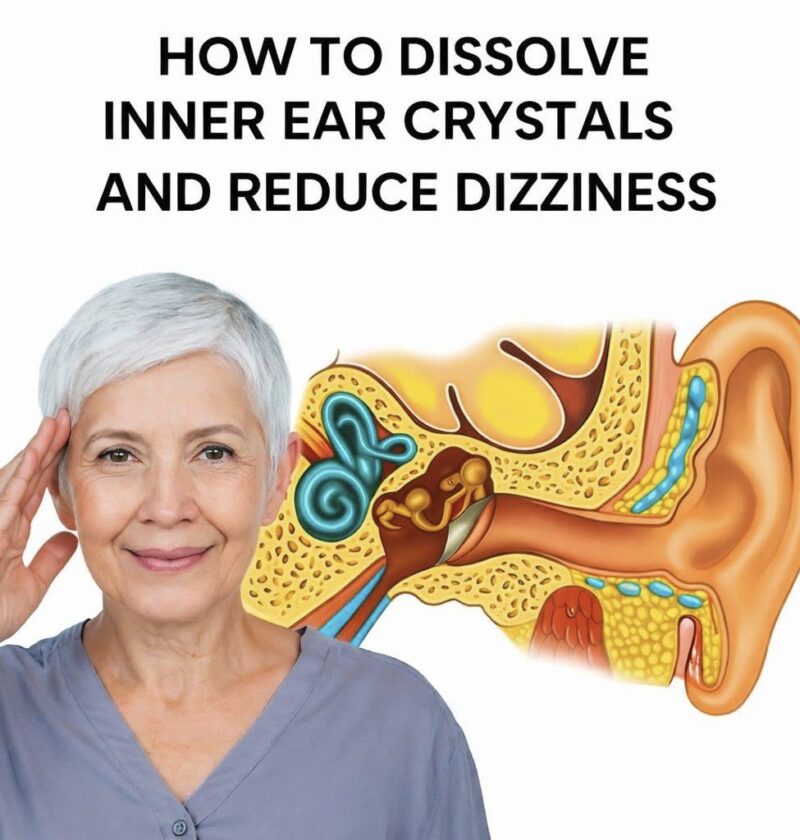
Here’s a safer, evidence-based version. “Inner-ear crystals” usually refers to BPPV (benign paroxysmal positional vertigo), where tiny calcium crystals move into the wrong part of the inner ear. Repositioning maneuvers such as the Epley maneuver can often help. (Mayo Clinic)
🌀 How to Get Rid of “Inner-Ear Crystals” and Reduce Vertigo
If you feel the room suddenly spinning when you turn over in bed, look up, bend down, or move your head, you may have a condition called BPPV.
BPPV happens when tiny calcium crystals in the inner ear become displaced and enter the balance canals. (Mayo Clinic)
👂 The usual treatment: repositioning maneuvers
The Epley maneuver uses a series of controlled head and body movements to move the crystals back to where they no longer trigger vertigo. It often works after one or two treatments. (Mayo Clinic)
A healthcare professional can determine which ear and canal are affected and teach you the appropriate maneuver. This is important because the correct exercise depends on the type of BPPV.
🛏️ What about exercises at home?
Some people are taught Brandt-Daroff exercises when appropriate. They can be performed at home, but they may temporarily make you feel dizzy, so use a safe location and have someone nearby if you’re at risk of falling. (Rotherham NHS Foundation Trust)
⚠️ Don’t assume every case of vertigo is “ear crystals”
Vertigo can have many causes. Seek urgent medical attention if dizziness is accompanied by new weakness or numbness, difficulty speaking, severe headache, fainting, chest pain, sudden vision changes, or difficulty walking.
If you have significant neck or back problems, certain blood-vessel conditions, or other medical concerns, ask a healthcare professional before attempting a repositioning maneuver because the movements can carry risks. (Mayo Clinic)
❤️ Bottom line: BPPV is often treatable, and you don’t need to live with recurring positional vertigo. The safest approach is to confirm the diagnosis and use the maneuver appropriate for your affected ear and canal.