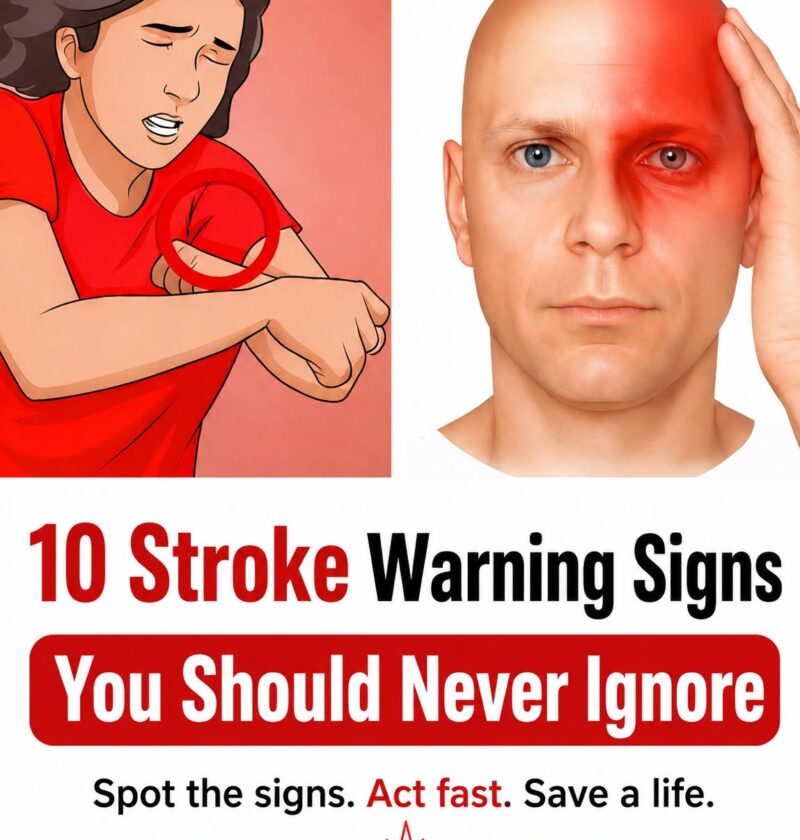
If you want this as a detailed health-content piece, I’d make the headline slightly more accurate: there isn’t a reliable set of symptoms that predicts a stroke exactly one month in advance. A TIA (“warning stroke”) can precede a major stroke, and its symptoms can be sudden and temporary. (www.stroke.org)
🧠 A Month Before a Stroke? 10 Warning Signs You Should Never Ignore
A stroke does not always happen completely “out of nowhere.” Some people experience a transient ischemic attack (TIA) beforehand—a temporary interruption of blood flow to the brain that can cause stroke-like symptoms. A TIA is a medical emergency, even when the symptoms disappear. (www.stroke.org)
🚨 10 Signs That Can Signal a Stroke or TIA
1. Sudden weakness on one side
One arm, leg, or side of the body suddenly feels weak or numb.
2. Facial drooping
One side of the face may suddenly droop or feel numb. Ask the person to smile and check whether the smile is uneven.
3. Sudden difficulty speaking
Speech may become slurred, confused, or difficult to understand.
4. Trouble understanding speech
You may suddenly have difficulty understanding what another person is saying.
5. Sudden vision changes
Blurred, double, or lost vision in one or both eyes can occur with a TIA or stroke.
6. Sudden dizziness or loss of balance
Unexpected dizziness, difficulty walking, or loss of coordination can be a warning sign.
7. A sudden, severe headache
A severe headache with no obvious cause—particularly when it appears suddenly—requires urgent medical attention.
8. Sudden confusion
A person may become unexpectedly confused, disoriented, or unable to communicate normally.
9. Temporary stroke-like symptoms
Symptoms that last only a few minutes and then disappear should NOT be dismissed. This may be a TIA, sometimes called a “warning stroke.” (www.stroke.org)
10. Repeated episodes of these symptoms
A series of brief neurological episodes can be especially concerning and should be medically evaluated immediately.
⚠️ The Most Important Thing to Remember
These symptoms do not mean that a stroke will definitely happen within a month. There is no reliable countdown that predicts exactly when a stroke will occur.
But sudden neurological symptoms—even if they completely disappear—can be a warning of serious problems. TIAs are associated with an increased risk of a subsequent stroke, particularly in the days and weeks afterward. (www.stroke.org)
🆘 Remember B.E. F.A.S.T.
B — Balance: sudden loss of balance or coordination
E — Eyes: sudden vision changes
F — Face: facial drooping
A — Arms: weakness or numbness
S — Speech: difficulty speaking or understanding
T — Time: call emergency medical services immediately
If any of these symptoms appear suddenly, seek emergency medical help immediately—even if the symptoms go away. Stroke treatment is highly time-sensitive, and getting care quickly can reduce the risk of permanent disability. (www.stroke.org)
❤️ Don’t wait for symptoms to become severe. Know the signs, act quickly, and share this information with your family.