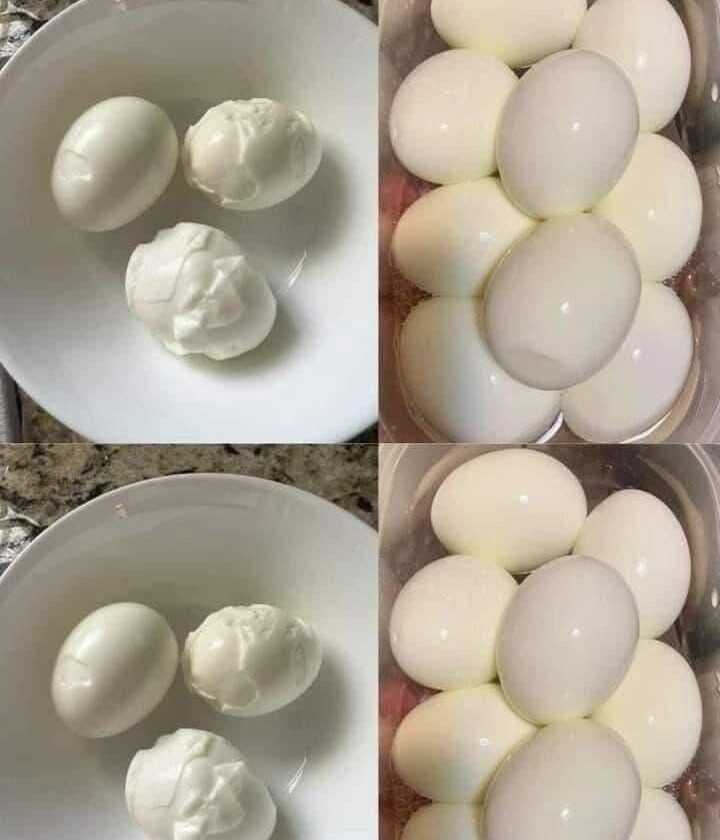
🥚 Cook’s Smart Trick for Easily Peeling Hard-Boiled Eggs
If hard-boiled eggs always seem to stick to the shell, the biggest difference usually comes from how you cook and cool them, rather than a secret ingredient.
The easiest method
1. Start with already-boiling water
Gently lower the eggs into boiling water with a spoon. Starting in hot water can make peeling easier than starting eggs in cold water, although egg age also matters.
2. Cook for about 10–12 minutes
For fully hard-cooked eggs, keep the water at a gentle boil. Adjust the time slightly depending on egg size and your preferred yolk texture.
3. Transfer immediately to an ice bath 🧊
As soon as they’re done, place the eggs in ice-cold water for at least 5–10 minutes. Rapid cooling helps separate the egg from the shell and stops the cooking process.
4. Crack the shell all over
Tap the egg gently against a hard surface, then roll it between your hands to create lots of small cracks.
5. Peel under running water
Start at the larger end, where there is usually an air pocket. Slip a finger underneath the membrane and peel gently. A little running water can help separate the shell.
⭐ One more useful trick
Use older eggs rather than extremely fresh eggs when possible. Fresh eggs tend to have a lower pH, which makes the egg white adhere more strongly to the inner shell membrane. As eggs age, the pH rises and peeling generally becomes easier. (extension.illinois.edu)
What about adding baking soda or vinegar?
You’ll see advice to add baking soda, vinegar or salt to the cooking water. These tricks are much less important than using suitable eggs and cooling them quickly, and results can vary.
Bottom line: For reliably easy-to-peel hard-boiled eggs, try boiling-water cooking + immediate ice bath + peeling from the large end. And if you’re planning ahead, don’t use the freshest eggs in your refrigerator.