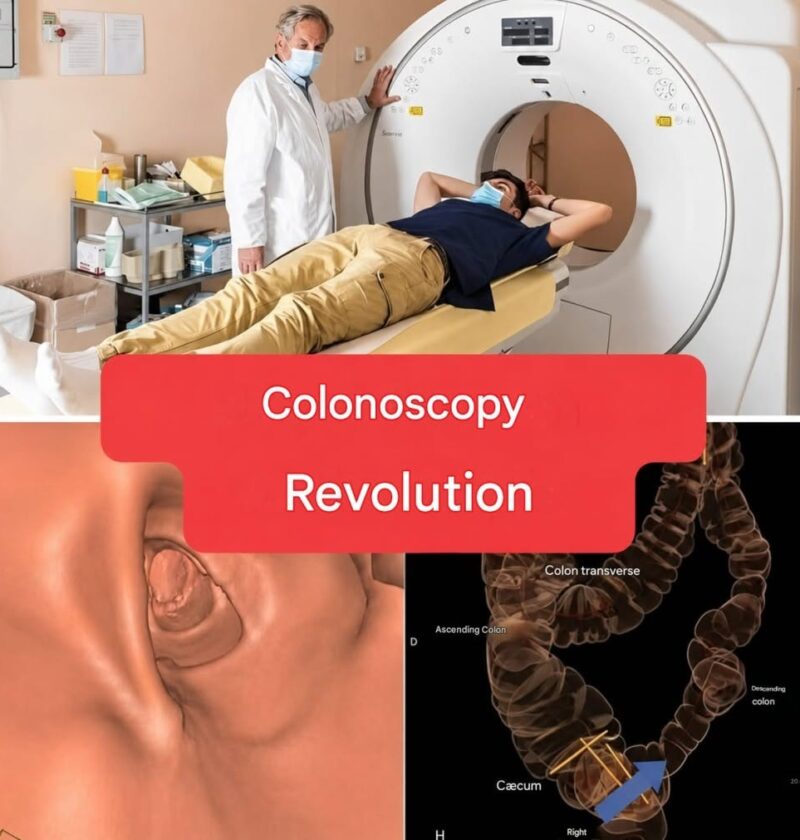
“New method: colonoscopy will no longer be an invasive examination. (1/2)”
is a medical news–style headline that suggests a major change in how colon examinations are performed. It is likely referring to newer, less invasive screening technologies, but the wording can be exaggerated.
A traditional colonoscopy involves inserting a flexible camera through the rectum to examine the colon. It remains one of the most effective tests because doctors can:
- Directly view the colon lining
- Find suspicious areas
- Remove precancerous polyps during the same procedure
- Take tissue samples if needed
Less invasive alternatives being developed or already available
1. CT colonography (“virtual colonoscopy”)
- Uses CT scans to create images of the colon.
- Does not require a camera inserted through the entire colon.
- If a concerning polyp is found, a regular colonoscopy may still be needed for removal or biopsy.
2. Stool-based screening tests
Examples include:
- Fecal immunochemical tests (FIT)
- Stool DNA tests
These look for signs of colorectal cancer without an invasive procedure, but they do not remove polyps.
3. Capsule-based technologies
- Small camera capsules that are swallowed are being studied and used in some settings.
- They may offer a more comfortable way to examine parts of the digestive tract, but they do not fully replace colonoscopy in all situations.
The reality
Colonoscopy is unlikely to “disappear” completely soon. Instead, the future of colorectal screening is likely to involve more options, with less invasive tests used for many people and traditional colonoscopy reserved for cases where direct examination or treatment is needed.
The headline’s claim is more accurately described as: new methods may reduce the need for some invasive colonoscopies, but they have not completely replaced the procedure.