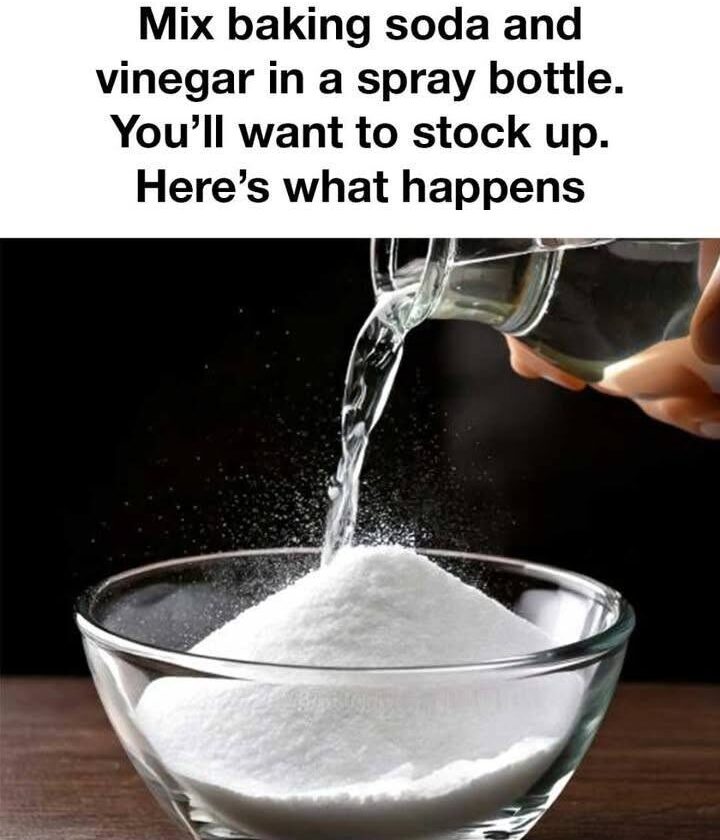
The claim that baking soda and vinegar make a “powerful cleaning agent” when mixed together is misleading.
🧪 What actually happens?
Baking soda is alkaline (basic), while vinegar contains acetic acid. When you combine them, they react immediately:
baking soda + vinegar → carbon dioxide + water + sodium acetate
That’s why you see the dramatic fizzing and bubbling. The bubbles can help loosen dirt mechanically, but the reaction also neutralizes much of the acidity and alkalinity. Once the reaction is largely finished, you’re mainly left with water and sodium acetate—not a uniquely powerful cleaner.
Where they can still be useful
Baking soda:
- Scrubbing sinks and other surfaces
- Deodorizing refrigerators and some household items
- Loosening grime when used as a mild abrasive
Vinegar:
- Removing some mineral/limescale deposits
- Dissolving soap residue
- Cleaning some glass and hard surfaces
For many jobs, it’s actually better to use them separately rather than mix them.
⚠️ Don’t put the mixture in a sealed spray bottle
This is particularly important. The reaction produces carbon dioxide gas. If you mix baking soda and vinegar in a closed container, pressure can build up and the container may leak, burst, or spray its contents unexpectedly.
And never mix vinegar with chlorine bleach or ammonia-containing cleaners. Those combinations can produce dangerous gases.
Bottom line: The satisfying fizz doesn’t mean you’ve created a super-cleaner. For most household cleaning, baking soda and vinegar work better separately, chosen according to the type of dirt you’re trying to remove.