Here’s a polished version that keeps the attention-grabbing headline while making clear that these signs do not automatically mean dementia. Several other conditions, medications, or deficiencies can cause similar symptoms. (nhs.uk)
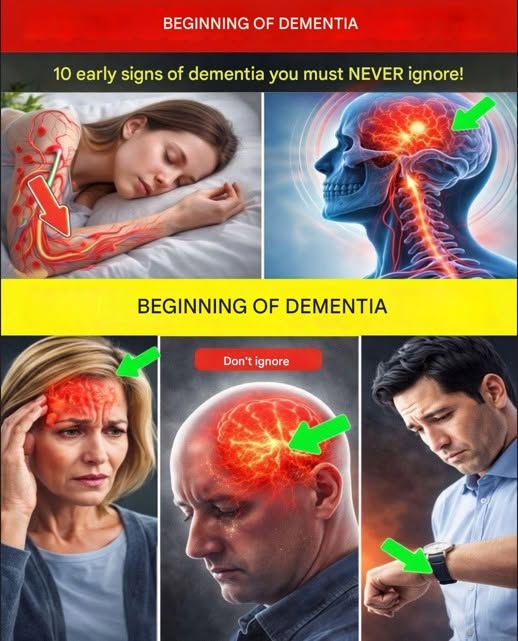
🧠 10 Early Signs of Dementia You Shouldn’t Ignore
Occasionally forgetting a name or misplacing your keys is a normal part of life. But persistent changes that interfere with everyday activities deserve medical attention. Dementia is not a normal part of aging. (nhs.uk)
1. 🧠 Memory loss that affects daily life
Frequently forgetting recently learned information, repeating questions, or increasingly relying on others to remember things.
2. 🧩 Trouble planning or solving problems
Difficulty managing bills, following a familiar recipe, or completing tasks that require organization.
3. 🏠 Difficulty completing familiar tasks
Struggling with everyday activities that were previously routine, such as cooking, driving, or using familiar appliances.
4. 📅 Confusion about time or place
Losing track of dates, seasons, where you are, or how you got somewhere.
5. 👁️ Trouble judging distances or visual information
Problems with spatial relationships, reading, balance, or recognizing contrast can sometimes occur.
6. 🗣️ Increasing difficulty with words
Struggling to follow conversations, find familiar words, name everyday objects, or repeatedly losing track of what you’re saying.
7. 🔍 Frequently misplacing things
Putting objects in unusual places and being unable to retrace your steps to find them.
8. ⚖️ Poorer judgment or decision-making
Unusual changes in financial decisions, personal safety, or judgment may be warning signs.
9. 😔 Withdrawing from hobbies or social activities
Losing interest in activities, conversations, or relationships that were previously important.
10. 😟 Changes in mood or personality
Unusual increases in anxiety, suspicion, fear, irritability, or other personality changes can occur. (Alzheimer’s Association)
⚠️ One important point
Having one of these symptoms doesn’t prove that someone has dementia. Memory and thinking problems can also be related to medications, vitamin deficiencies, depression, infections, sleep problems, or other treatable conditions. (Alzheimer’s Association)
If these changes are persistent, worsening, or interfering with everyday life, make an appointment with a doctor for an evaluation. Early assessment can help identify the cause and provide appropriate treatment and support. (Alzheimer’s Association)
❤️ Don’t panic—but don’t ignore persistent changes in memory, thinking, or behavior either.