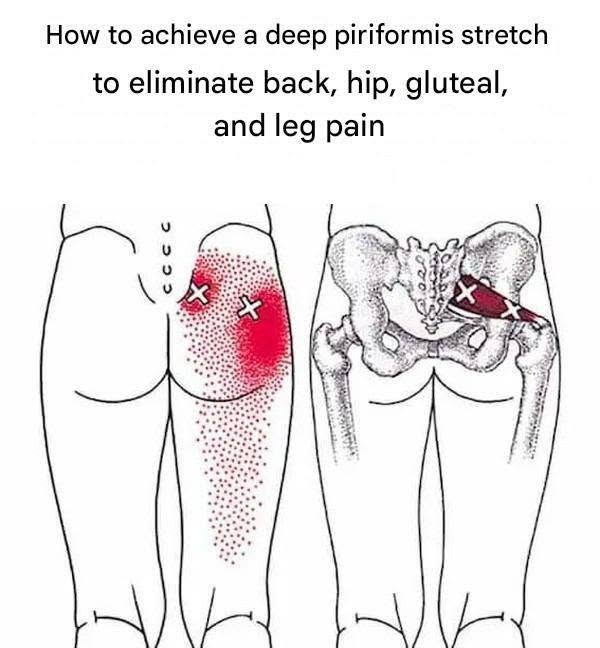
A “piriformis stretch” can help some people with tight glutes or irritation of the sciatic nerve area, but it’s not a guaranteed cure for all back, hip, or leg pain. Those symptoms can come from many causes (disc issues, arthritis, nerve compression, etc.), so think of this as supportive mobility work, not a treatment for everything.
The piriformis muscle sits deep in the glutes and can sometimes irritate the sciatic nerve if it’s tight.
🧘♂️ Safe, effective deep piriformis stretches
1. Figure-4 stretch (most common)
- Lie on your back
- Cross one ankle over the opposite knee (making a “4” shape)
- Pull the uncrossed leg toward your chest
- Hold 20–30 seconds, repeat 2–3 times each side
👉 You should feel it deep in the glute, not sharp pain.
2. Seated figure-4 stretch
- Sit upright in a chair
- Cross one ankle over the opposite knee
- Lean forward gently with a straight back
- Hold 20–30 seconds
Good for office or elderly people.
3. Pigeon pose (deeper stretch)
- From a plank or hands-and-knees position
- Bring one knee forward and rotate it outward
- Extend the other leg back
- Lower your body slowly
⚠️ Only go as far as comfortable—don’t force it.
4. Supine hip twist
- Lie on your back
- Cross one leg over the body toward the floor
- Keep shoulders flat
- Hold and breathe slowly
⚠️ Important safety notes
Stop if you feel:
- Sharp or shooting pain down the leg
- Numbness or tingling worsening
- Pain in the lower back increasing
These may suggest nerve involvement (like true sciatica or disc irritation), where stretching alone may not be enough.
💡 What actually helps long-term
For piriformis-related discomfort:
- Gentle stretching daily
- Glute strengthening (bridges, clamshells)
- Walking and light movement
- Avoid long sitting without breaks
🧠 Key reality check
A tight piriformis is only one possible cause of back/leg pain. If pain is:
- Persistent
- One-sided and radiating
- Worsening over time
it’s worth checking for nerve or spinal causes.
If you want, tell me where exactly your pain starts and where it travels (buttock, thigh, calf, etc.), and I can help you figure out whether it actually sounds like piriformis syndrome or something else.