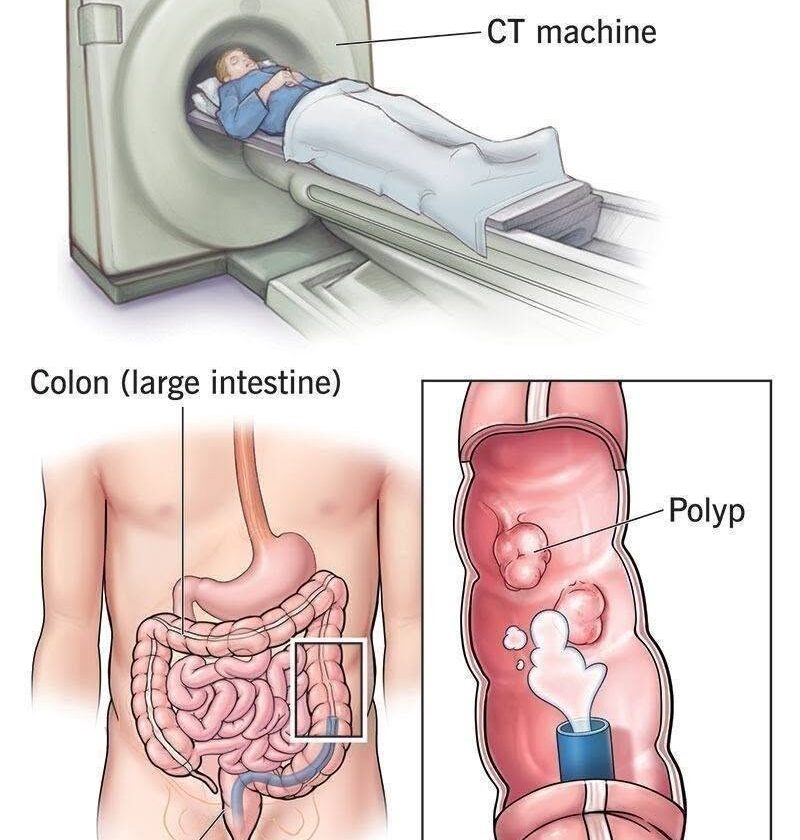
A colonoscopy has not stopped being an invasive procedure, and there is currently no new medical method that replaces standard colonoscopy as a fully non-invasive equivalent.
🧪 What a colonoscopy actually is
A colonoscopy is still a procedure where a doctor:
- Inserts a thin flexible camera (colonoscope) through the rectum
- Visually examines the colon lining
- Can remove polyps or take biopsies during the same procedure
Because of this physical insertion, it is still classified as invasive in medicine.
🧠 Why you may be seeing this claim
These posts usually mix up colonoscopy with newer non-invasive screening options:
🧫 1) Stool-based tests (non-invasive)
- FIT (Fecal Immunochemical Test)
- Stool DNA tests (e.g., Cologuard-type tests)
These:
- Detect blood or DNA changes in stool
- Are completely non-invasive
- BUT cannot replace colonoscopy if something abnormal is found
📷 2) Imaging-based tests (less invasive, not same)
- CT colonography (“virtual colonoscopy”)
- Uses CT scans to view the colon
Still requires bowel prep and:
- No camera inside the body
- Cannot remove polyps (so follow-up colonoscopy may still be needed)
⚠️ Key limitation
Even with newer methods:
If something suspicious is found, a traditional colonoscopy is still required to confirm and treat it.
So they reduce how often you need colonoscopy—but do not eliminate it.
🧠 Bottom line
Colonoscopy has not become non-invasive. What has improved are screening alternatives that can reduce how often people need one, but they do not replace it for diagnosis and treatment.
If you want, I can explain which screening option is best by age or risk level, or how these tests compare in accuracy.