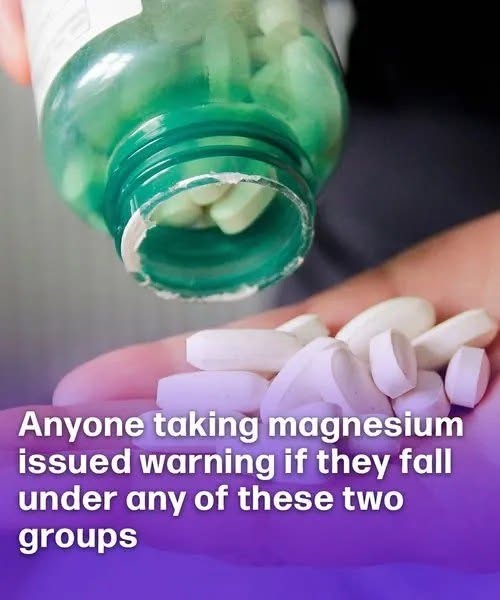
The headline “Health Experts Issue New Warning About Magnesium Supplements — Especially for These Two High-Risk Groups” sounds urgent, but the underlying message is generally that magnesium supplements are not appropriate for everyone. For most healthy adults taking recommended doses, they are considered safe.
The two groups most often considered at higher risk are:
1. People with kidney disease
This is the most important group.
Healthy kidneys remove excess magnesium from the body. If kidney function is significantly reduced, magnesium can build up in the blood (hypermagnesaemia), which can cause:
- Nausea and vomiting
- Muscle weakness
- Low blood pressure
- Slow heartbeat
- Drowsiness or confusion
- In severe cases, breathing difficulties or heart rhythm problems
People with moderate or severe kidney disease should only take magnesium supplements if advised by their healthcare professional.
2. People taking certain medications
Magnesium can interact with some medicines, including:
- Certain antibiotics (such as tetracyclines and fluoroquinolones), reducing their absorption.
- Levothyroxine (thyroid hormone replacement), making it less effective if taken at the same time.
- Bisphosphonates for osteoporosis, whose absorption can also be reduced.
- Some medicines that affect magnesium levels or kidney function.
A pharmacist or prescriber can advise on whether these medicines should be taken several hours apart from magnesium.
Other people who should be cautious
- People with certain heart rhythm disorders.
- Anyone using magnesium-containing laxatives or antacids regularly, as these also contribute to total magnesium intake.
- People who are pregnant or breastfeeding should use supplements according to medical advice or recommended daily intake.
Signs you may be taking too much magnesium
Common side effects include:
- Diarrhoea (the most common)
- Stomach cramps
- Nausea
These are more likely with forms such as magnesium citrate or magnesium oxide, especially at higher doses.
Bottom line
For most people, magnesium supplements are safe when taken as directed. The biggest concerns are:
- Reduced kidney function, where magnesium can accumulate.
- Interactions with certain medications, which may reduce the effectiveness of either the magnesium or the other medicine.
If you’re considering magnesium because of symptoms such as leg cramps, poor sleep, or fatigue, it’s worth discussing whether a supplement is likely to help, as those symptoms can have many different causes.