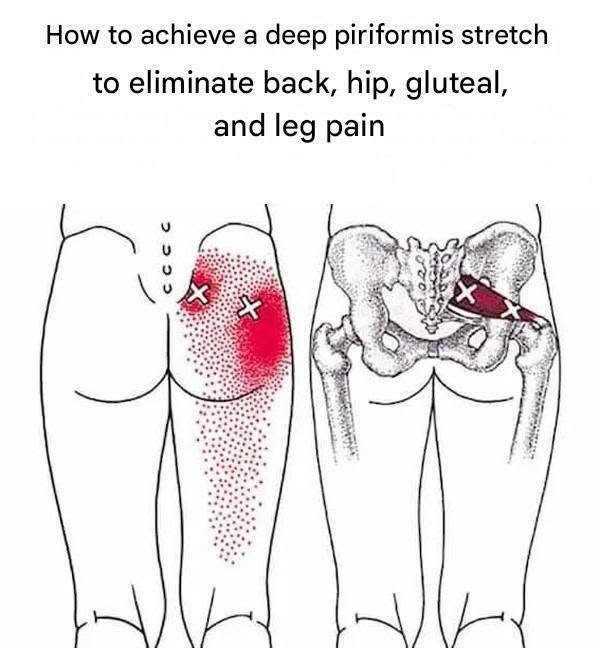
A deep piriformis stretch can help reduce tightness in the outer hip and may ease some glute/hip discomfort and sciatic-like irritation, but it’s important to be honest: it won’t “eliminate all back, hip, gluteal, and leg pain” if the cause is something like a disc issue, arthritis, or nerve compression. It can, however, be very helpful when tight muscles are part of the problem.
The key muscle is the piriformis, a small deep hip rotator that can irritate the sciatic nerve when tight.
Best deep piriformis stretches (safe and effective)
1. Figure-4 stretch (lying down – most effective)
- Lie on your back
- Cross right ankle over left knee
- Pull left thigh gently toward your chest
- Keep head relaxed on the floor
You should feel it in the right outer hip/glute.
Hold 20–40 seconds, repeat 2–3 times each side.
2. Seated figure-4 stretch
- Sit upright in a chair
- Place right ankle over left knee
- Lean forward slowly with a straight back
Good for people who can’t lie on the floor.
3. Pigeon pose (deep stretch)
- From a plank or tabletop, bring one knee forward
- Extend the other leg back
- Lower your torso slowly toward the floor
This gives a stronger, deeper stretch—but go gently.
4. Supine assisted stretch (deeper variation)
- Do the figure-4 position
- Instead of pulling the thigh, gently press the crossed knee outward while pulling the leg in
This increases piriformis and deep hip rotation stretch.
How to do it correctly (this matters more than the pose)
- Keep movements slow and controlled
- Don’t bounce
- Stop if you feel sharp pain, tingling, or numbness
- Aim for a “deep stretch,” not pain
- Hold each stretch 20–60 seconds, repeat 2–3 times daily
Important reality check (very important)
If your pain is:
- shooting down the leg
- associated with numbness/weakness
- worse when sitting or coughing
…it may not be just piriformis tightness. It could involve the sciatic nerve or lumbar spine, and stretching alone won’t solve it.
What actually improves results long-term
- Glute strengthening (bridges, clamshells)
- Hip mobility work
- Reducing long sitting time
- Core stability exercises
If you want, tell me where your pain is strongest (buttock, lower back, thigh, calf), and I can help you figure out whether it really looks like piriformis syndrome or something else.