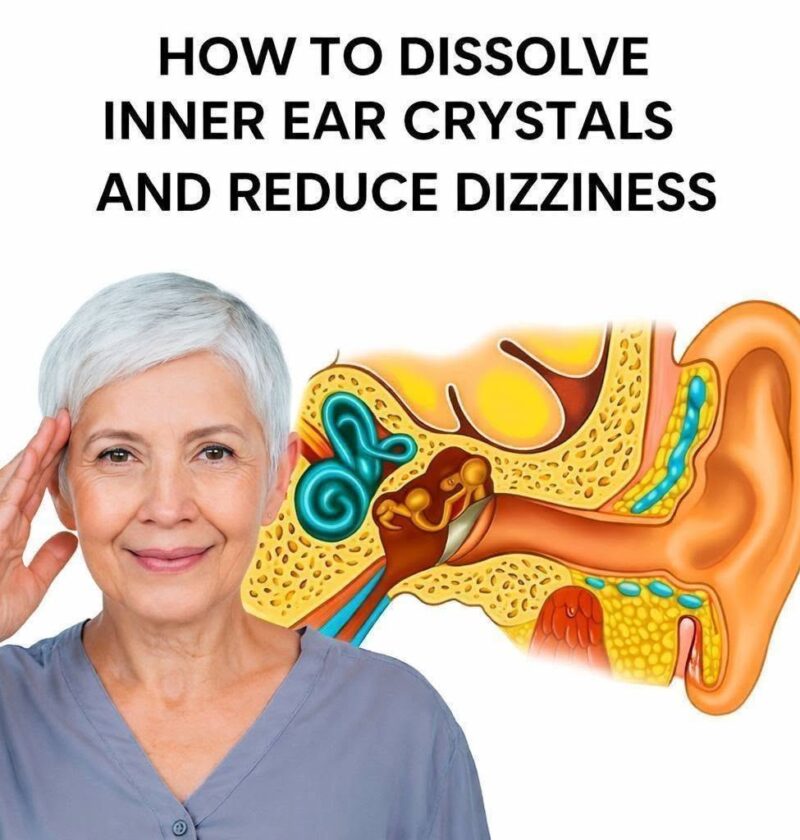
🌀 How to Get Rid of “Inner Ear Crystals” and Reduce Vertigo
What people often call “inner-ear crystals” is usually benign paroxysmal positional vertigo (BPPV). Tiny calcium crystals (otoconia) normally sit in a part of the inner ear called the utricle. If they become displaced into a semicircular canal, certain head movements can trigger a brief spinning sensation. (Hopkins Medicine)
1. The Epley maneuver is the main treatment
For the most common type of BPPV, the Epley maneuver uses a sequence of head and body movements to guide the displaced crystals back to where they belong. It can often relieve the vertigo without medication. (Hopkins Medicine)
If the right ear is affected:
- Sit on your bed and turn your head 45° to the right.
- Quickly lie back, keeping your head turned; wait about 30 seconds.
- Turn your head 90° to the left; wait 30 seconds.
- Turn your head and body another 90° to the left, so you’re lying on your side; wait 30 seconds.
- Slowly sit up.
For the left ear, reverse the directions. (Hopkins Medicine)
It’s normal for the maneuver to temporarily make you feel dizzy. Having someone nearby is sensible the first time.
⚠️ Make sure it’s actually BPPV
The Epley maneuver is designed specifically for BPPV. It isn’t appropriate for every cause of vertigo. A clinician can determine which ear and which semicircular canal are involved and teach you the correct maneuver. (Hopkins Medicine)
Don’t perform it without medical advice if you have significant neck or back problems, certain vascular conditions, or retinal problems, because some of the positions may be unsafe. (Hopkins Medicine)
What else can help?
If the Epley maneuver isn’t appropriate or doesn’t completely resolve the problem, a vestibular therapist may use other repositioning maneuvers or exercises, such as Brandt-Daroff exercises. (Hopkins Medicine)
BPPV can also return months or years later, so recurrence doesn’t necessarily mean something serious has developed. (Hopkins Medicine)
🚨 When vertigo needs urgent attention
Don’t assume sudden dizziness is “ear crystals.” Seek urgent medical evaluation if vertigo occurs with new weakness or numbness, trouble speaking, double vision, severe headache, fainting, chest pain, inability to walk, or other sudden neurological symptoms.
Bottom line: If your vertigo consists of brief spinning attacks triggered by rolling over in bed, looking up, bending, or changing head position, BPPV is a possibility, and the Epley maneuver is often highly effective. (Hopkins Medicine)