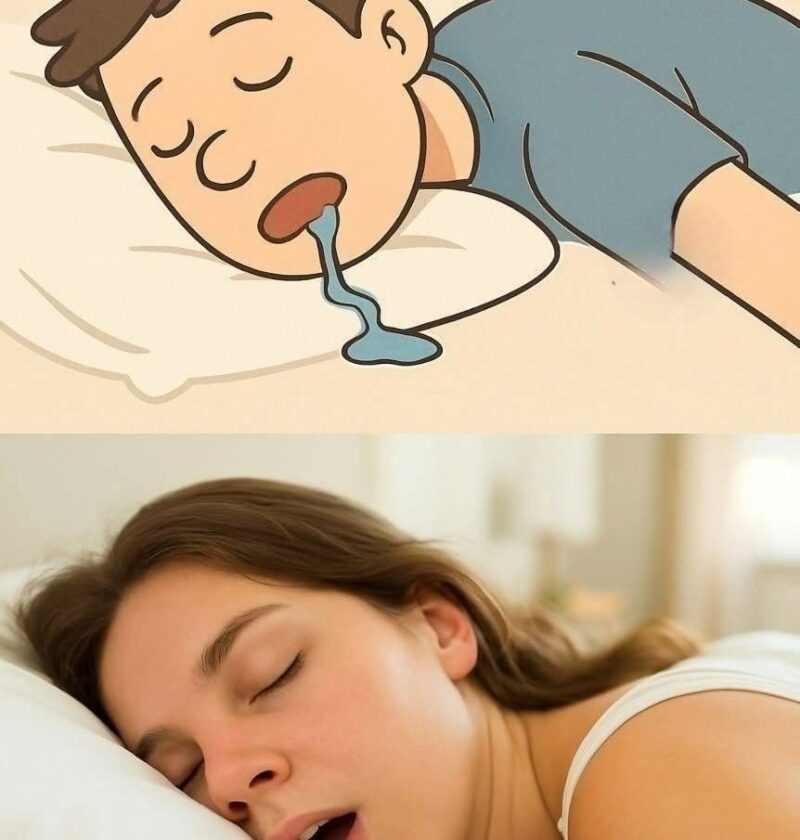
That headline is misleading. Drooling while asleep does not automatically mean that your brain is developing a serious disease.
😴 Why do people drool during sleep?
Common explanations include:
- Sleeping on your side or stomach — saliva can escape more easily.
- Mouth breathing from nasal congestion, allergies, or a blocked nose.
- Excess saliva, sometimes related to medications or dental/oral problems.
- Acid reflux in some people.
- Sleep apnea can be associated with mouth breathing and nighttime drooling.
🧠 What about the “brain” claim?
Some neurological disorders can cause difficulty swallowing or controlling saliva, which may lead to drooling. But drooling by itself is not a reliable early warning sign of Alzheimer’s, Parkinson’s, stroke, or another brain disorder.
What matters is whether drooling occurs together with other new symptoms—such as difficulty swallowing, slurred speech, facial weakness, significant changes in movement, confusion, or weakness/numbness on one side.
If drooling suddenly appears along with facial drooping, speech difficulty, or one-sided weakness, seek emergency medical care because those can be signs of a stroke.
For ordinary nighttime drooling without other symptoms, it is usually much more likely to be related to sleep position, mouth breathing, or nasal congestion than to a brain problem.