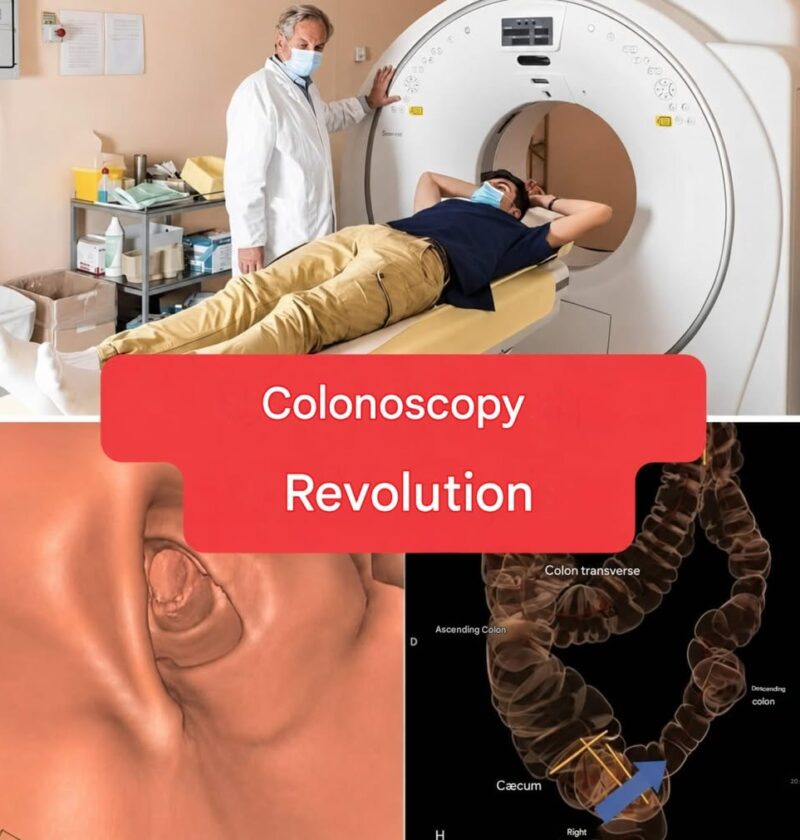
Yes—but the headline is a little misleading. Colonoscopy itself has not suddenly become non-invasive. What has changed is that several newer technologies may allow doctors to screen the colon without inserting a conventional colonoscope.
1. AI + CT “virtual colonoscopy”
One promising 2026 development is COCA, an AI-based system that analyzes non-contrast CT scans to detect colorectal cancer. In a large multicenter study, researchers developed the system using scans from more than 2,600 people. The idea is to use an ordinary CT examination plus deep-learning analysis rather than physically passing a scope through the colon.
S
ScienceDirect
This could make screening:
Non-invasive — no endoscope needs to be inserted.
No sedation — unlike many conventional colonoscopies.
Potentially easier to scale — CT scanners are already widely available.
AI-assisted — the algorithm searches the CT images for patterns associated with colorectal cancer.
However, this is not yet a replacement for conventional colonoscopy. If the CT detects a suspicious polyp or cancer, a conventional colonoscopy may still be required to biopsy or remove it.
2. Capsule endoscopy
Another approach is colon capsule endoscopy: you swallow a small capsule containing cameras. It travels through the digestive tract and takes thousands of images of the colon.
AI is increasingly being used to analyze these images. A 2026 meta-analysis reported pooled sensitivity of about 93% and specificity of about 95% for AI-assisted detection of colorectal polyps, although the studies were highly heterogeneous.
A
ASCO Publications
So this is closer to what people mean when they say “colonoscopy without the scope.”
3. Blood and stool tests
There is also rapid development of genuinely non-invasive blood and stool screening. For example, an experimental blood test reported in August 2026 detected 92% of stage I–III colorectal cancers and 81% of advanced adenomas in a study of more than 1,500 people.
R
Reuters
But these tests have an important limitation: they don’t let the doctor see or remove a polyp. A positive result generally still needs follow-up colonoscopy.
The important bottom line
As of August 2026, conventional colonoscopy remains the most comprehensive examination because it can simultaneously:
directly inspect the entire colon,
take biopsies, and
remove polyps.
Current evidence describes non-invasive tests as complementary rather than replacements for colonoscopy, particularly when an abnormality needs to be investigated or removed.
S
ScienceDirect
+1
So if the claim you saw says “colonoscopy will no longer be invasive,” it probably refers to one of these emerging alternatives—not to the conventional procedure itself.
S
A
R
Sources