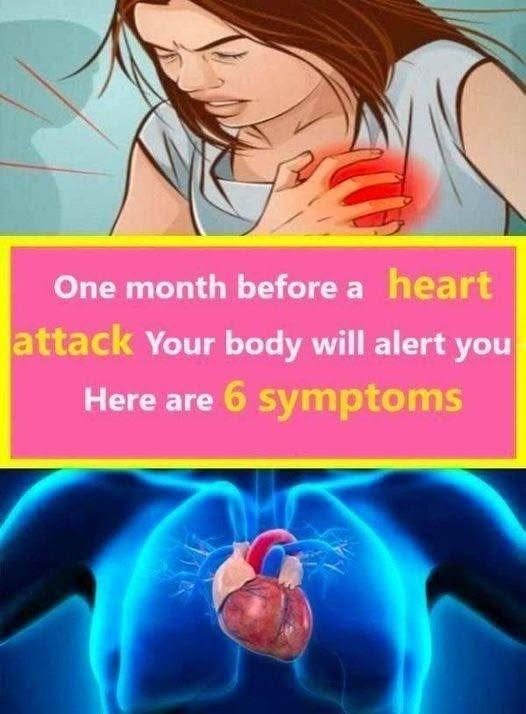
One Month Before a Heart Attack: 6 Warning Signs You Should Know
The headline is partly misleading. There is no scientifically proven set of six symptoms that reliably appears exactly one month before a heart attack. However, some people do experience warning symptoms hours, days, or even weeks beforehand.
M
Mayo Clinic
+1
1. Chest pressure or discomfort
You may feel pressure, squeezing, tightness, fullness, or aching in the center of your chest. It may come and go. Recurrent chest pressure, particularly with activity, can be a sign of angina and needs medical evaluation.
W
www.heart.org
+1
2. Shortness of breath
Breathlessness can occur with chest discomfort or sometimes by itself. Unexplained or new shortness of breath should not be ignored.
M
Mayo Clinic
3. Unusual fatigue
Some people experience unusual or unexplained tiredness, particularly when it is new or substantially different from their normal energy level.
W
www.heart.org
4. Pain outside the chest
Heart-related discomfort can spread to the arm or shoulder, back, neck, jaw, teeth, or upper abdomen.
M
Mayo Clinic
5. Nausea or indigestion
Nausea, vomiting, heartburn, or indigestion can sometimes accompany a heart attack. These symptoms can be particularly easy to mistake for a stomach problem.
M
Mayo Clinic
6. Cold sweating, dizziness, or lightheadedness
Breaking out in a cold sweat, feeling suddenly dizzy or lightheaded, or feeling faint can occur during a heart attack.
W
www.heart.org
+1
Women may have different or less obvious symptoms
Although chest discomfort remains the most common heart-attack symptom in women, women may also experience shortness of breath, nausea, vomiting, unusual fatigue or weakness, and pain in the back, shoulder, arm, or jaw.
W
www.heart.org
🚨 Don’t wait for a “one-month warning”
If you have new chest pressure/pain, trouble breathing, cold sweating, faintness, or pain spreading to your arm, back, neck, or jaw, treat it as an emergency. Call your local emergency medical service immediately rather than waiting for the symptoms to pass.
M
Mayo Clinic
+1
Bottom line: Some heart attacks have warning symptoms weeks beforehand, but many occur suddenly. The important thing isn’t predicting a heart attack one month ahead—it’s recognizing symptoms and getting emergency treatment quickly.
M
W
Sources