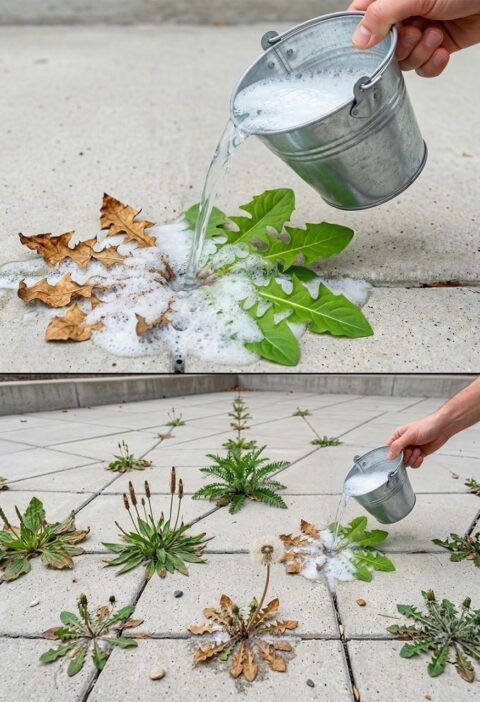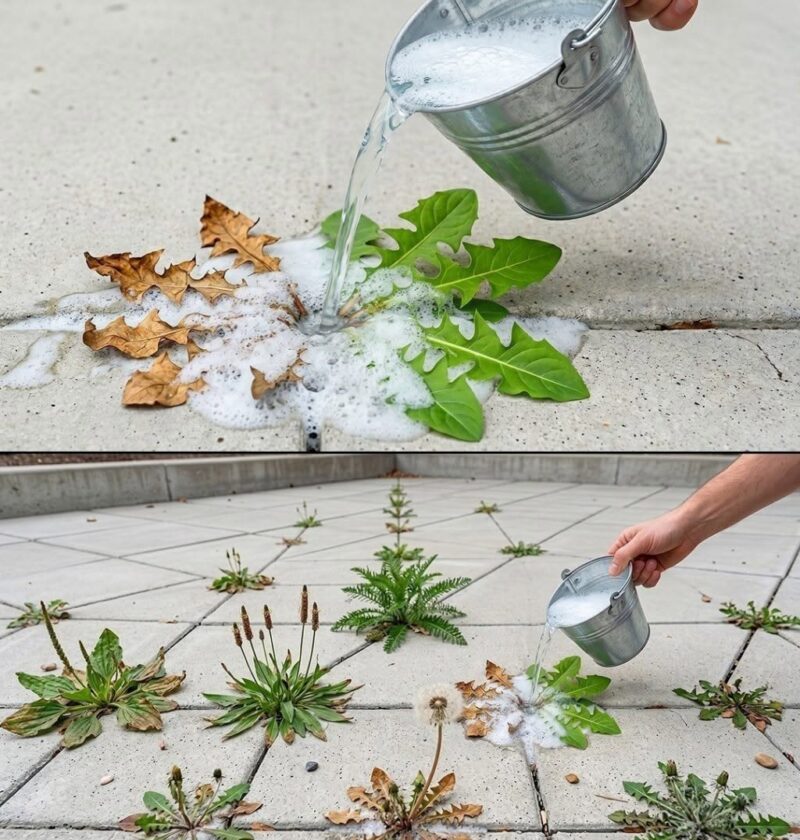
The truth is that some substances can quickly kill the visible parts of weeds, but permanently eliminating weeds is much more difficult. Understanding how weeds grow can help you choose the most effective and environmentally responsible control methods.
Why Weeds Keep Coming Back
Many weeds are remarkably resilient. Even if the leaves and stems are destroyed, the roots may remain alive underground. Some species can regrow from tiny root fragments, while others produce seeds that remain viable in the soil for years.
Because of this, a weed that appears dead today may reappear weeks or months later.
Popular “Natural” Weed Killers
Vinegar Solutions
One of the most common homemade weed-control methods uses vinegar.
Vinegar contains acetic acid, which can damage plant tissue on contact.
Pros:
- Works quickly on small, young weeds
- Easy to obtain
- Breaks down naturally in the environment
Cons:
- Usually kills only the above-ground portion
- Deep roots often survive
- Can harm nearby desirable plants
Salt Mixtures
Some recipes combine salt and vinegar.
Salt can dehydrate plants and prevent growth.
Pros:
- Effective at killing vegetation
Cons:
- Can damage soil quality
- May prevent future planting
- Can spread beyond the target area
For this reason, salt is generally not recommended for gardens where you hope to grow plants later.
Boiling Water
A simple kettle of boiling water can kill weeds growing between paving stones or cracks.
Pros:
- No chemical residue
- Immediate results on small weeds
Cons:
- May require repeated applications
- Less effective on large-rooted weeds
Why “Never Grow Again” Is Misleading
No household remedy can guarantee that weeds will never return. New seeds constantly arrive through:
- Wind
- Birds
- Rainwater
- Foot traffic
- Nearby vegetation
Even when existing weeds are removed, new ones can germinate later.
Long-Term Weed Prevention
The most effective long-term strategies focus on prevention:
Mulching
A thick layer of mulch blocks sunlight and reduces weed germination.
Regular Maintenance
Removing weeds before they produce seeds dramatically reduces future infestations.
Landscape Fabric
In certain areas, weed barriers can reduce growth while still allowing water to penetrate.
Healthy Plant Coverage
Dense lawns and ground covers leave less space for weeds to establish themselves.
Environmental Considerations
Many homemade weed-killer recipes circulate online, but not all are environmentally friendly. Overuse of salt, for example, can harm soil organisms and nearby plants. Even natural substances should be used thoughtfully.
The Bottom Line
Some treatments can indeed burn weeds within a day, especially young weeds exposed to vinegar, boiling water, or other contact methods. However, the claim that weeds will “never grow again” is unrealistic. Effective weed control usually requires a combination of removal, prevention, and ongoing maintenance.
The best approach depends on where the weeds are growing—whether it’s a vegetable garden, flower bed, driveway, walkway, or lawn. What works well in one location may not be ideal in another.