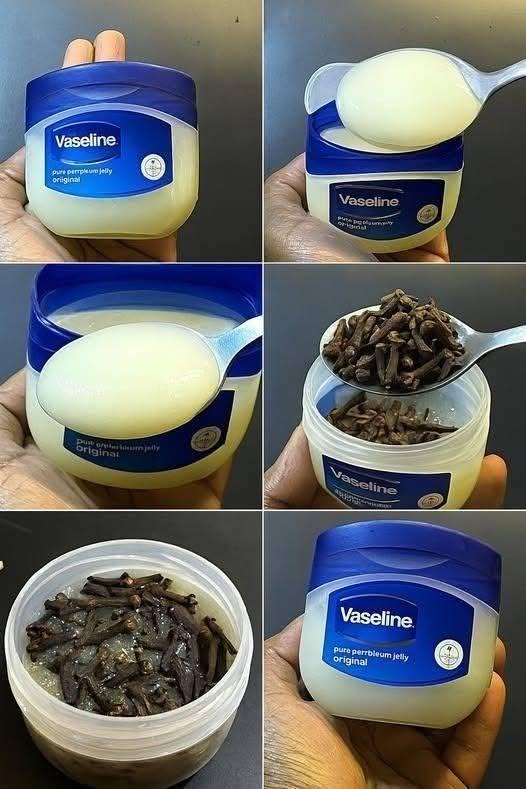
The claim “Mix cloves with petroleum jelly: a secret no one will ever tell you” is another common social-media teaser. The actual benefits depend on what the mixture is being used for.
What the ingredients do
- Clove contains compounds such as eugenol, which has been studied for antimicrobial and mild pain-relieving properties.
- Vaseline (or other petroleum jelly products) acts mainly as a skin protectant and moisturizer by creating a barrier that reduces moisture loss.
Common claims
People online claim that a clove–petroleum jelly mixture can:
- Reduce wrinkles.
- Lighten skin.
- Treat fungal infections.
- Relieve joint pain.
- Repel insects.
Most of these claims have little or no strong clinical evidence behind them. While cloves and petroleum jelly each have legitimate uses, combining them does not create a scientifically proven cure for skin, pain, or medical conditions.
Potential risks
- Clove oil or concentrated clove preparations can irritate the skin and may cause allergic reactions.
- Applying strong clove mixtures to sensitive areas can lead to redness, burning, or dermatitis.
- Petroleum jelly can trap substances against the skin, potentially increasing irritation if the clove preparation is too strong.
If you want to try it
For cosmetic use, it’s safest to:
- Use a very small amount of clove-infused oil rather than concentrated clove oil.
- Mix it thoroughly with petroleum jelly.
- Patch-test on a small area of skin for 24–48 hours before wider use.
If you saw a specific video or recipe, share it and I can evaluate whether its claims are plausible or misleading.