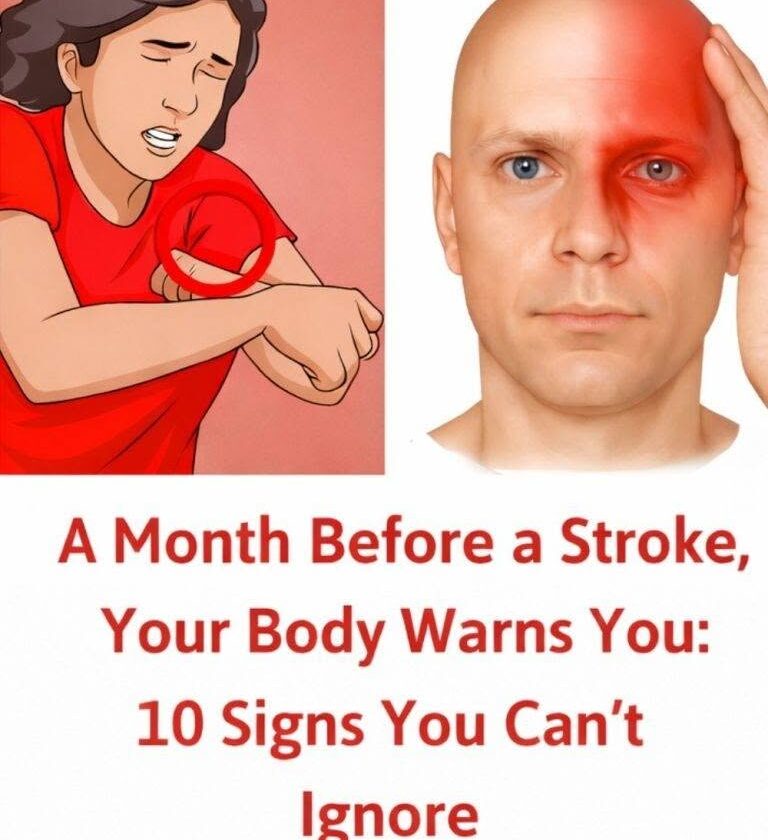
A Month Before a Stroke, Your Body Warns You: 10 Signs Not to Ignore
The claim that your body reliably gives 10 specific warnings exactly one month before a stroke is misleading. A stroke can happen suddenly, and there is no medically established “one-month warning checklist.”
However, some people experience a transient ischemic attack (TIA) beforehand. A TIA produces the same kinds of neurological symptoms as a stroke, but they usually disappear within minutes or hours. It is a medical emergency and an important warning of possible stroke. (www.stroke.org)
10 symptoms that should never be ignored
- Sudden numbness or weakness, especially on one side of the face, arm, or leg.
- Sudden facial drooping or an uneven smile.
- Sudden difficulty speaking or understanding speech.
- Sudden vision changes, including blurred, double, or lost vision.
- Sudden dizziness or loss of balance.
- Sudden difficulty walking or coordinating movements.
- Sudden confusion or trouble understanding what is happening.
- A sudden severe headache with no obvious cause.
- Brief episodes of these symptoms that completely disappear—possible TIA.
- Repeated episodes of neurological symptoms, even if each episode lasts only a few minutes. (www.stroke.org)
Remember B.E. F.A.S.T.
B — Balance: sudden loss of balance or coordination
E — Eyes: sudden vision changes
F — Face: facial drooping
A — Arms: weakness or numbness in an arm
S — Speech: slurred or difficult speech
T — Time: seek emergency medical help immediately. (www.stroke.org)
Don’t wait for symptoms to disappear
A particularly dangerous misconception is that a brief episode is harmless. TIA symptoms can disappear, but they still require urgent medical evaluation. You cannot reliably determine at home whether an episode was a TIA or an actual stroke. (www.stroke.org)
Bottom line: There is no reliable way to predict a stroke one month in advance. But sudden neurological symptoms—whether they last minutes or persist—should be treated as an emergency. Fast treatment can reduce brain damage and disability. (www.stroke.org)