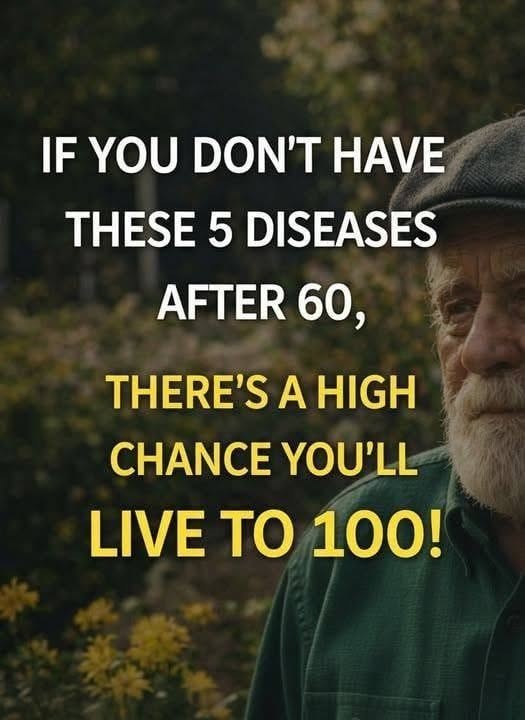
That claim is misleading. There is no reliable medical rule that says “if you reach age 60 without 5 specific diseases, you’ll likely live to 100.” Longevity is influenced by many overlapping factors, not a simple checklist.
What research actually shows about living longer
Studies on long-lived populations (like centenarians) suggest that reaching very old age is more about:
- Genetics (important, but not decisive)
- Lifestyle over decades
- Heart and metabolic health
- Avoiding smoking
- Physical activity
- Social connection and mental health
- Access to healthcare
Even among people who reach 100, many still develop diseases later in life—just at a slower rate or later onset.
Diseases that do strongly affect lifespan risk
Certain conditions are associated with higher mortality risk if not controlled:
- Heart disease (especially uncontrolled hypertension or coronary artery disease)
- Stroke
- Type 2 diabetes
- Chronic kidney disease
- Chronic lung disease (like COPD)
But having (or not having) these at 60 does not determine your lifespan. Many people live into their 80s–90s with one or more of these conditions under good management.
Why the “5 diseases” idea is misleading
These posts usually:
- Oversimplify complex aging biology
- Ignore treatment advances (modern medicine changes outcomes a lot)
- Confuse “risk factors” with “destiny”
- Ignore variability in genetics and environment
A more accurate way to think about it
A better predictor of healthy aging is:
- Blood pressure control
- Blood sugar stability
- Cholesterol levels
- Regular movement
- Not smoking
- Maintaining muscle strength and balance
Bottom line
Reaching 60 without major chronic disease is a good sign of health, but it is not a guarantee of reaching 100. Longevity depends on long-term habits and overall health trajectory, not a single age checkpoint.
If you want, I can break down what actually characterizes “super-agers” (people who stay sharp and active past 85–90).