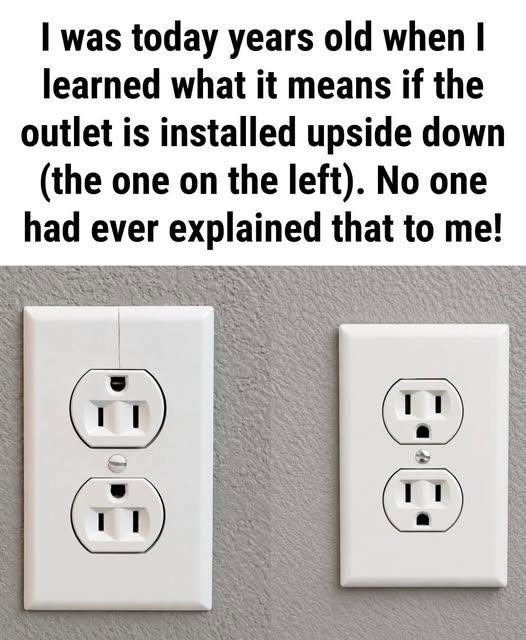
If you mean an electrical wall outlet installed upside down—with the ground hole on top rather than the bottom—it usually does not mean anything is wrong.
Why are some outlets installed this way?
There are several possible reasons:
Electrician preference: There is no universal requirement in the U.S. that the ground slot must be on the bottom.
Safety consideration: In some installations, putting the ground pin on top can reduce the chance of a falling metal object bridging the energized and neutral contacts if a plug partially comes out.
Switching conventions: An upside-down receptacle can sometimes indicate that it is controlled by a wall switch, although this is not a reliable universal code.
Specific installation requirements: Some commercial, institutional, or local electrical practices may specify a particular orientation.
Is it dangerous?
Not simply because it’s upside down. The important issues are whether the receptacle is properly wired, grounded, rated for the circuit, and securely installed.
If an outlet is loose, hot to the touch, sparking, buzzing, discolored, or producing a burning smell, stop using it and have a qualified electrician inspect it.
One useful clue: If only one outlet in a room is upside down while the others aren’t, it may have been intentionally installed that way to identify a switched or otherwise special receptacle—but don’t assume that without testing or checking the wiring.