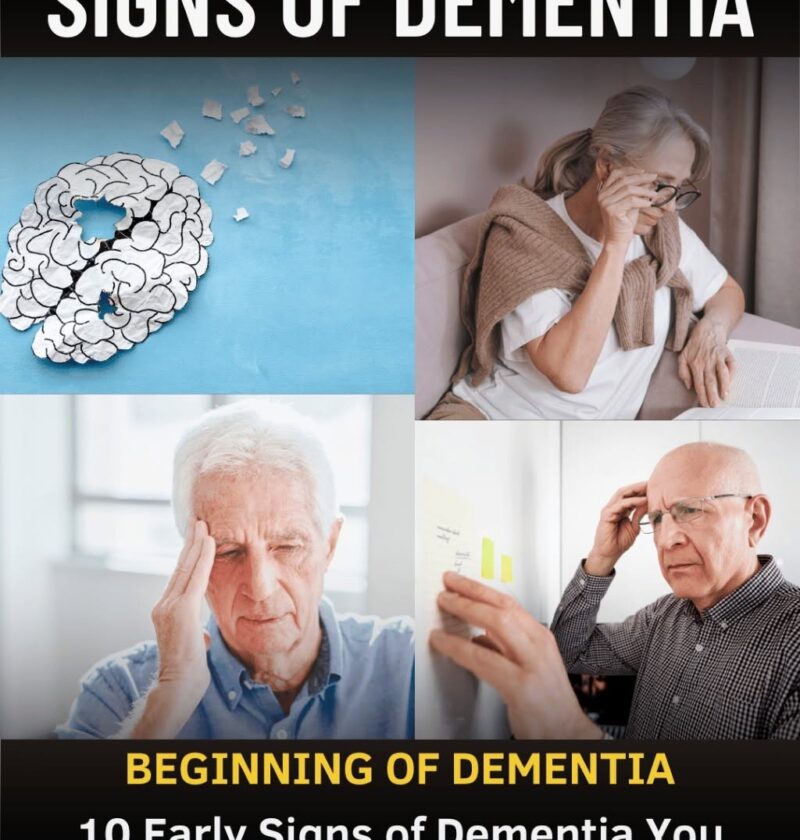
10 Early Signs of Dementia You Should Never Ignore
Dementia is not a normal part of aging. Occasional forgetfulness can be normal, but persistent changes that interfere with everyday life deserve medical attention.
N
National Institute on Aging
+1
1. Repeating the same questions or stories — especially forgetting that the question was already answered.
2. Forgetting recently learned information — such as recent conversations, appointments, or events.
3. Getting lost in familiar places — or becoming unusually confused about dates, locations, or how to get somewhere.
4. Trouble managing money or bills — including missed payments or increasingly poor financial decisions.
N
National Institute on Aging
+1
5. Difficulty completing familiar tasks — such as following a familiar recipe, operating an appliance, or managing a routine activity.
6. Increasing difficulty finding words — struggling to follow or participate in conversations can be an early warning sign.
N
National Institute on Aging
+1
7. Poorer judgment — making decisions that are clearly unusual or risky compared with the person’s previous behavior.
8. Frequently misplacing things and being unable to retrace their steps — rather than simply occasionally losing keys or glasses.
9. Withdrawal or noticeable personality changes — becoming unusually apathetic, anxious, suspicious, irritable, or socially withdrawn.
N
National Institute on Aging
10. Increasing difficulty with planning and problem-solving — for example, struggling with a familiar sequence of tasks or handling ordinary household responsibilities.
Don’t assume it’s dementia
Several potentially treatable problems—including medication effects, depression, thyroid problems, vitamin deficiencies, and other medical conditions—can cause memory or thinking difficulties. A doctor can investigate the underlying cause.
N
National Institute on Aging
One crucial distinction: dementia generally develops gradually. Sudden confusion is different and can be an emergency. If someone becomes suddenly confused or disoriented, seek medical help immediately rather than assuming it’s dementia.
N
nhs.uk
If these changes are persistent or progressively worsening, arranging a medical evaluation sooner rather than later is sensible. Early assessment can identify treatable causes and, when dementia is present, help with diagnosis and planning.
N
National Institute on Aging
N
N
Sources