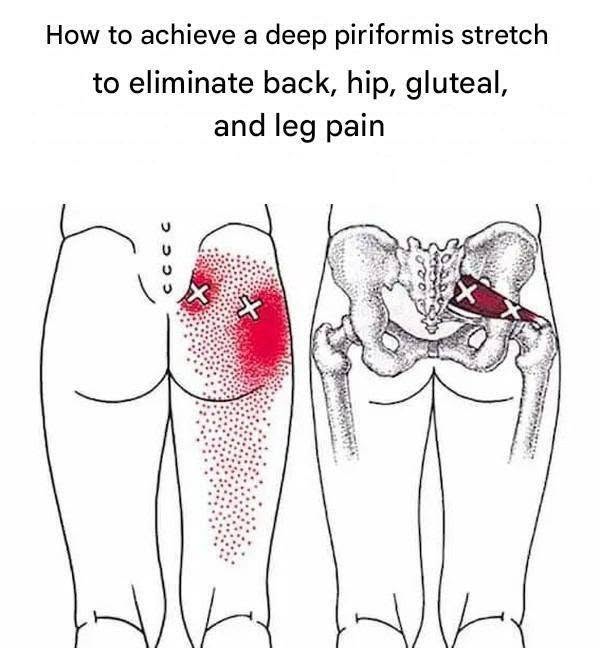
How to Stretch the Piriformis SafelyThe piriformis is a small muscle deep in the buttock that helps rotate and stabilize the hip. Tightness in this muscle can contribute to pain in the buttock and, in some people, irritation of the nearby sciatic nerve. However, not all back, hip, glute, or leg pain is caused by the piriformis, so a stretch is not a universal cure.
Stretch 1: Figure-4 Stretch (Lying Down)
- Lie on your back with both knees bent.
- Cross your right ankle over your left knee, forming a “4.”
- Reach behind your left thigh and gently pull it toward your chest.
- You should feel a stretch deep in the right buttock.
- Hold for 20–30 seconds, then switch sides.
- Repeat 2–4 times on each side.
Stretch 2: Seated Figure-4 Stretch
- Sit upright in a chair.
- Place one ankle on the opposite knee.
- Keep your back straight and lean forward from your hips.
- Hold for 20–30 seconds, then repeat on the other side.
Stretch 3: Knee-to-Opposite-Shoulder Stretch
- Lie on your back with your legs extended.
- Bend one knee and gently pull it toward the opposite shoulder.
- Keep your shoulders relaxed.
- Hold for 20–30 seconds, then switch sides.
Tips for stretching
- Stretch gently—you should feel tension, not sharp pain.
- Breathe normally; don’t hold your breath.
- Stretch 3–5 days per week if it feels comfortable.
- Stop if the pain worsens, especially if it radiates down the leg.
Other things that may help
- Regular walking or light activity
- Strengthening the hip and glute muscles
- Taking breaks from prolonged sitting
- Applying heat before stretching if muscles feel tight
When stretching may not be appropriate
See a healthcare professional if you have:
- Severe or worsening pain
- Significant weakness or numbness
- Loss of bladder or bowel control
- Pain after a major fall or injury
- Fever, unexplained weight loss, or persistent pain that doesn’t improve
If your pain travels below the knee, is associated with numbness or tingling, or began after lifting something heavy, the cause may be something other than a tight piriformis, such as a spinal nerve problem. In that case, a medical evaluation is a good idea.
If you describe where your pain starts, where it travels, and what movements make it better or worse, I can help you determine whether a piriformis stretch is likely to be appropriate.