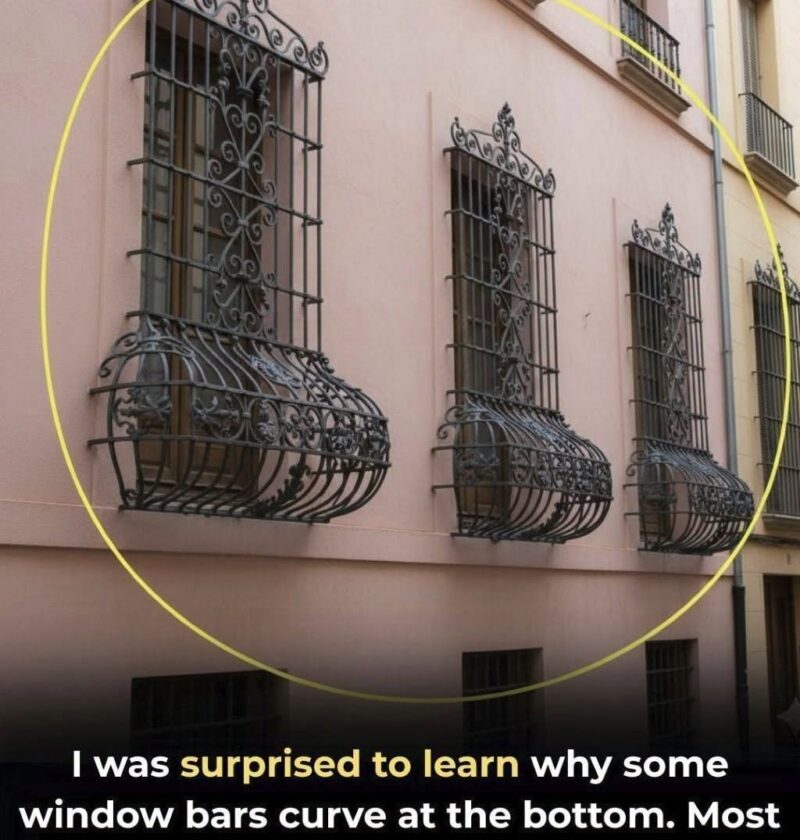
🪟 Those Curved Bars at the Bottom of Window Grilles Aren’t Just Decoration
If you’ve noticed older wrought-iron window grilles that bulge outward near the bottom, you’ve probably wondered why they were made that way.
They’re sometimes called “belly bars” or “potbelly” window grilles, and the curve can serve several practical purposes—not simply decoration. (House Digest)
🌸 1. They can make room for plants
One of the most useful explanations is that the outward curve creates extra space between the window and the grille, allowing flower boxes or planters to sit outside without interfering with the security bars. This was particularly useful in dense urban areas where people had little outdoor space. (Home Remedies Easy)
🛡️ 2. They still provide a security barrier
Window grilles historically served as physical security, helping prevent unauthorized entry while allowing windows to remain open for ventilation. The outward shape can also increase the distance between the window and the bars, making it harder to reach through a broken window. (Qsec)
🌬️ 3. They allow the window to remain useful
Instead of having a flat metal barrier pressed directly against the window, the projecting section creates a small usable zone outside it. Depending on the design, that space could accommodate plants or other objects while still maintaining a protective barrier.
🏛️ 4. They became part of the architecture
Traditional wrought-iron grilles weren’t purely utilitarian. Blacksmiths incorporated elaborate curves and decorative motifs into security features, turning something necessary into an architectural feature. Historic iron grille work developed particularly rich decorative traditions in European architecture. (Wikipedia)
So the next time you see one, look twice: that graceful curve may represent a clever combination of security, limited urban space, gardening, and craftsmanship.
One caveat: there isn’t one universal explanation for every curved grille. The exact purpose depends on the building, region, and period; some were primarily decorative or architectural while others were designed around practical uses such as planters. (House Digest)