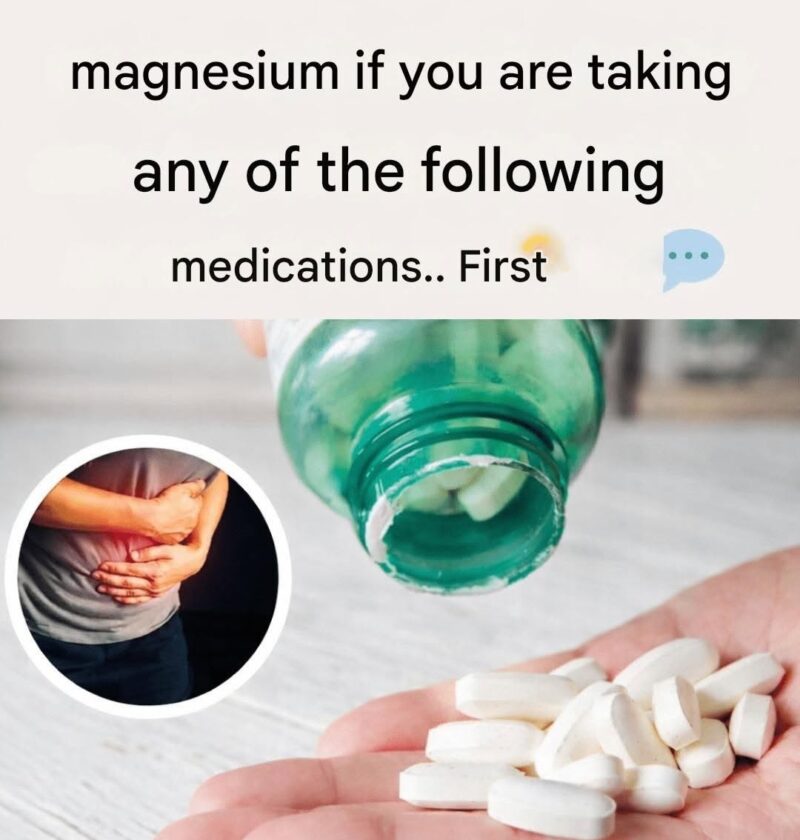
“NEVER Use Magnesium If You Are Taking Any of These Medications” — Fact-Check
That headline is too absolute. Magnesium supplements can interact with certain medications, but in many cases the solution is simply to separate the doses or monitor magnesium levels, rather than avoiding magnesium completely.
O
Office of Dietary Supplements
+1
Medications that deserve special attention
1. Doxycycline and other tetracycline antibiotics
Magnesium can bind these medicines in the digestive tract and reduce their absorption. Doxycycline should generally be taken at least 2 hours before or 4–6 hours after a magnesium-containing supplement.
O
Office of Dietary Supplements
2. Ciprofloxacin, levofloxacin and other quinolone antibiotics
The same type of interaction can occur. Magnesium should generally be separated from these antibiotics according to the medication’s instructions.
O
Office of Dietary Supplements
3. Oral bisphosphonates
Medicines such as alendronate can have reduced absorption if taken too close to magnesium. The NIH recommends separating magnesium from oral bisphosphonates by at least 2 hours.
O
Office of Dietary Supplements
4. Diuretics (“water pills”)
Drugs such as furosemide and hydrochlorothiazide can increase magnesium loss through urine. Conversely, amiloride and spironolactone can reduce magnesium loss. This is a reason for medical monitoring—not automatically a reason to avoid magnesium.
O
Office of Dietary Supplements
5. Proton-pump inhibitors (PPIs)
Long-term use of medicines such as esomeprazole and lansoprazole can sometimes cause low magnesium levels. In fact, magnesium supplementation may be used to correct that deficiency.
O
Office of Dietary Supplements
⚠️ Kidney disease is particularly important
Your kidneys eliminate excess magnesium. People with significantly impaired kidney function can therefore be at greater risk of magnesium accumulating to dangerous levels. Anyone with kidney disease should discuss magnesium supplements with a healthcare professional before taking them.
N
NIDDK
+1
Don’t confuse food magnesium with supplements
The interaction concerns are particularly relevant to magnesium supplements and magnesium-containing medicines. Magnesium naturally present in food is generally handled differently and is part of a normal diet.
Also, high supplemental doses can cause diarrhea, nausea, and abdominal cramping; extremely high levels can cause serious toxicity.
D
Digital Media API
Bottom line: Don’t stop a prescribed medication—or automatically avoid magnesium—because of this headline. Check the specific medication, magnesium product, dose, and timing with your pharmacist or doctor. The FDA recommends telling healthcare professionals about all prescription medicines, OTC drugs, vitamins, minerals, and supplements you use.
U
U.S. Food and Drug Administration
+1
If you give me the names of your medications and the type/dose of magnesium, I can check the combinations individually and explain exactly which ones need separation or caution.
O
N
D
Sources