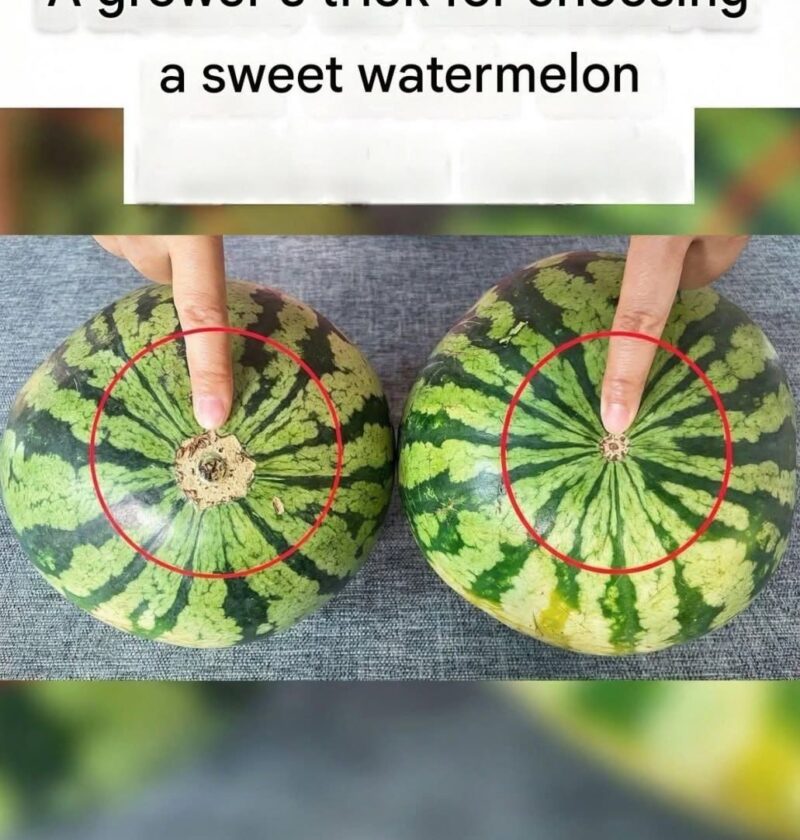
That headline points to advice that’s partly based on real signs, but it’s not foolproof. You can’t guarantee a sweet watermelon just by looking at it, though several visual cues can improve your chances.
Here are the best indicators:
🍉 Look for a creamy yellow field spot.
- This is the patch where the watermelon rested on the ground.
- A deep creamy yellow or golden spot usually means it ripened on the vine.
- A white or very pale spot may indicate it was picked too early.
🍉 Choose a dull, not shiny, rind.
- A matte finish often suggests the fruit is fully ripe.
- Very glossy watermelons can be less mature.
🍉 Pick one that feels heavy for its size.
- A heavier watermelon usually contains more water and is often juicier.
🍉 Look for a uniform shape.
- Whether round or oval, choose one that is symmetrical without dents or irregular bulges.
🍉 Check for “webbing” or brown sugar-like scars.
- Brown, rough webbing is often associated with good pollination. While not a guarantee of sweetness, many growers and shoppers consider it a positive sign.
🍉 If the stem is attached, look for a dry, brown stem.
- A green stem can mean the watermelon was harvested before it finished ripening.
What about tapping it?
Many people thump a watermelon and listen for a sound:
- A deep, hollow sound may indicate a ripe watermelon.
- A dull, flat sound can suggest it’s overripe or less juicy.
This method takes experience and isn’t as reliable as the other signs.
Bottom line
No visual guide can guarantee the sweetest watermelon, but combining these clues—a creamy yellow field spot, dull rind, heavy weight, symmetrical shape, and (if present) a dry stem—gives you the best chance of picking a ripe, sweet one.