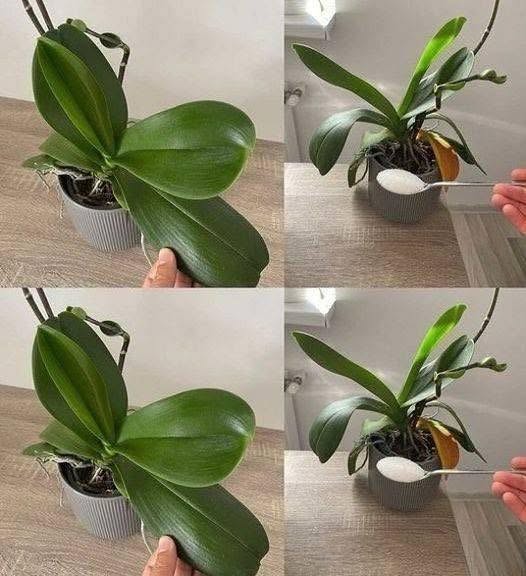
🌸 Orchids: “Just 1 Tablespoon and They’ll Bloom Non-Stop” — What Really Works
There isn’t a magic one-tablespoon homemade fertilizer that will make orchids bloom continuously. Orchid flowering depends on the plant’s species, maturity, light, temperature, watering, and overall health. Fertilizer helps, but it is only one part of the equation. (American Ornithological Society)
🌱 A safer feeding method
For a typical Phalaenopsis (moth orchid):
- Water the orchid first so the potting medium is thoroughly wet.
- Use a complete orchid fertilizer, preferably one containing micronutrients.
- Dilute it to about ¼ of the manufacturer’s recommended strength to start.
- Feed during active growth, generally about once a week or according to the product directions.
- Regularly flush the pot with plain water to prevent fertilizer salts from accumulating. (American Ornithological Society)
The American Orchid Society specifically recommends weak, regular feeding rather than strong doses, because excessive fertilizer can burn roots and damage the plant. (American Ornithological Society)
🌸 Want more flowers?
For many orchids, adequate light is more important than adding extra fertilizer. If a healthy Phalaenopsis produces lots of leaves but refuses to flower, insufficient light is one possibility. Orchids also need appropriate temperature and watering conditions. (American Ornithological Society)
Bottom line: Skip mystery “1 tablespoon” recipes unless you know exactly what the ingredient and concentration are. A dilute, balanced orchid fertilizer + appropriate light + proper watering is a much safer route to repeat blooming.