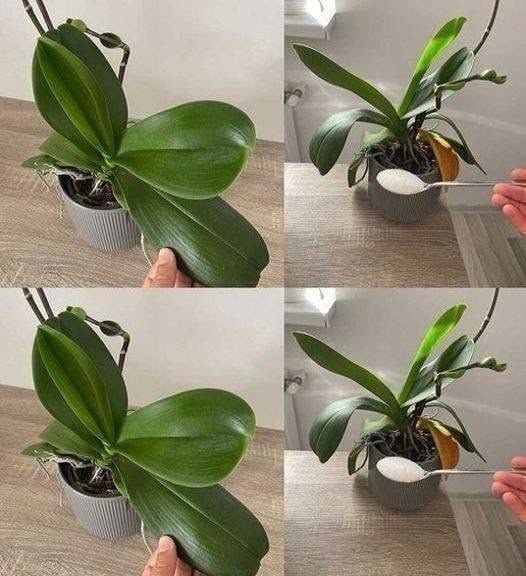
That claim is misleading. There is no “one tablespoon and orchids will bloom continuously” universal fertilizer trick.
Orchids are picky plants, and flowering depends on light, roots, watering, temperature, and balanced nutrients—not a single magical dose.
What’s likely behind the claim
People are usually referring to very diluted fertilizers or organic boosters, such as compost teas or banana-water mixtures. These can support growth, but they don’t guarantee continuous blooming.
For Orchid, flowering cycles are naturally seasonal or condition-based.
What actually makes orchids bloom
1) Proper light (most important)
Bright, indirect light is essential. Too little light = lots of leaves, no flowers.
2) Correct fertilizer (small amounts, not “one spoon magic”)
Orchids need balanced, diluted feeding like:
- Weak liquid fertilizer (often 1/4 strength)
- Higher nitrogen during growth, higher phosphorus for blooming
Over-fertilizing can actually damage roots.
3) Temperature difference
Many orchids bloom when there is a day–night temperature drop (about 5–10°C difference).
4) Healthy roots
If roots are damaged or waterlogged, the plant won’t flower no matter what you add.
Common “viral fertilizers” (what’s true vs false)
- Banana peel water → may add potassium but not a miracle bloom trigger
- Rice water → mild nutrients, but inconsistent results
- “One tablespoon fertilizer” → depends entirely on concentration and formula
None of these guarantee continuous flowering.
Reality check
Even healthy Orchid plants:
- Bloom only during specific cycles
- Often need rest periods
- Do not flower continuously year-round naturally
Bottom line
There is no single spoonful fertilizer that forces constant blooming. Orchids respond to balanced care + environment, not shortcuts.
If you want, I can give you a simple orchid care schedule (watering + feeding + light) that actually improves blooming frequency.