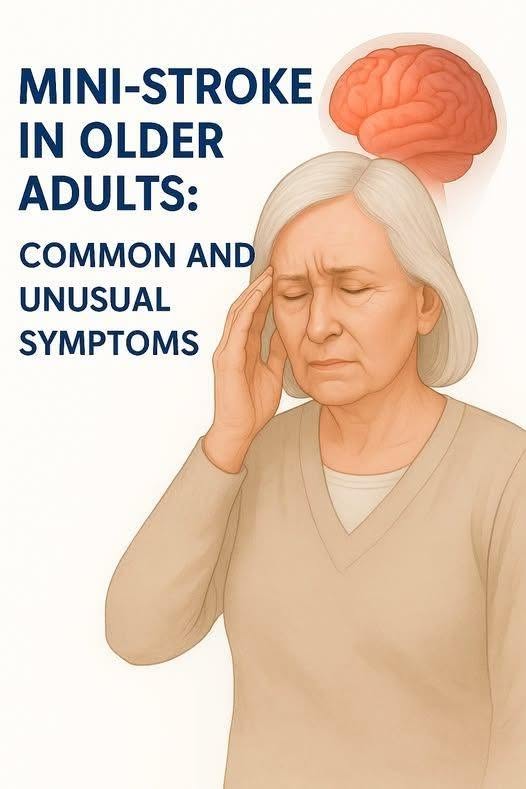
The headline “5 Critical Health Signals of a Mini Stroke in Seniors That Shouldn’t Be Ignored” is referring to a transient ischemic attack (TIA), commonly called a “mini-stroke” or, more accurately, a warning stroke. Its symptoms can disappear quickly, but that does not make it harmless. (www.stroke.org)
🚨 5 warning signs to know
1. Sudden weakness or numbness
Especially in the face, arm, or leg on one side of the body. One arm may suddenly drift downward when both arms are raised. (www.stroke.org)
2. Sudden difficulty speaking
Speech may become slurred, confused, or difficult to understand. A person may also suddenly have trouble understanding what others are saying. (nhs.uk)
3. Sudden vision problems 👁️
Temporary blindness, blurred vision, or double vision—particularly when it appears suddenly—can be a TIA symptom. (www.stroke.org)
4. Sudden loss of balance or coordination
Unexpected dizziness, difficulty walking, loss of coordination, or severe imbalance can occur. (www.stroke.org)
5. Sudden severe headache
A sudden, unusually severe headache without an obvious cause can accompany a stroke or TIA and requires urgent assessment. (www.stroke.org)
🧠 The most important point
A TIA may last only minutes or hours, and the person may appear completely normal afterward. Do not wait for the symptoms to return. TIA symptoms are the same as stroke symptoms when they begin, and distinguishing a TIA from an actual stroke requires medical assessment. (www.stroke.org)
Use B.E. F.A.S.T.:
- B — Balance: sudden loss of balance
- E — Eyes: sudden vision changes
- F — Face: one side drooping
- A — Arm: weakness or numbness
- S — Speech: difficulty speaking or understanding
- T — Time: call emergency medical services immediately (www.stroke.org)
If these symptoms are happening now—even if they are already improving—treat it as an emergency. Note the time the symptoms started and seek emergency medical care immediately. Early assessment can help identify the cause and reduce the risk of a subsequent stroke. (www.stroke.org)
A TIA is not something to treat at home with aspirin, herbal remedies, or waiting to see what happens; medical professionals need to determine the safest treatment.